Sub-Total: $0.00
Graphene: The Nanomaterial That Will Reshape the Modern World
What if a material was 200 times stronger than steel, harder than diamond, more conductive than silicon and copper, yet lighter than paper. The addition of those benefits to plastic, concrete, batteries, computer chips, and body armor is incomprehensibly disruptive. That material is Graphene.
What is Graphene?
Graphene is made up of a single two-dimensional layer of carbon atoms arranged in a hexagonal lattice, sometimes confused with graphite which consists of many stacked layers of graphene forming a three-dimensional structure. This nanomaterial graphene boasts extreme strength, flexibility, conductivity, and transparency. It was discovered back in 2004 by physicists Andre Geim and Konstantin Novoselov, who went on to win the Nobel Prize in Physics in 2010.
Surprisingly, graphene cannot be mined or found in a usable form. It’s typically derived from graphite or hydrocarbons through various chemical or mechanical processes, but there are new and exciting processes for making graphene that will change the world. That means its value is in not just the raw material, but innovation in the manufacturing of this “miracle material” and applying it at scale.
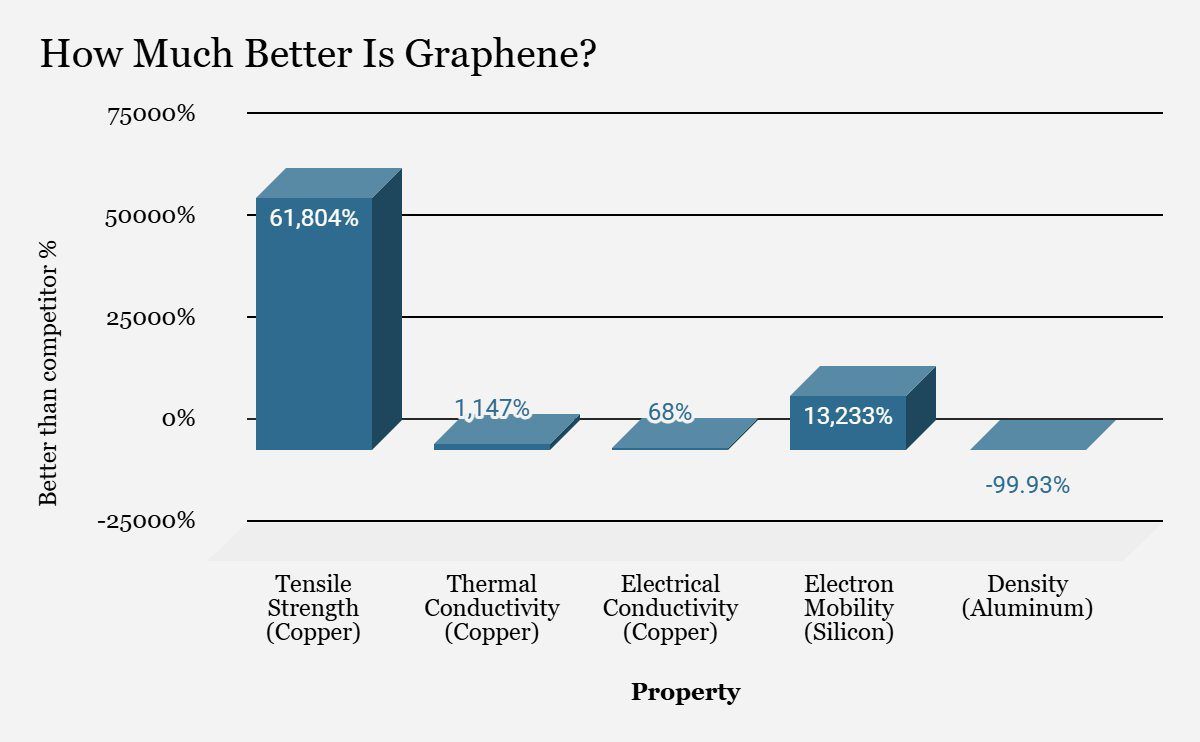
See just how incredible graphene is, showcasing its unmatched strength, flexibility, thermal and electrical conductivity, electron mobility, and extremely low density. It’s amazing to see how these unique properties are being put to use across industries, from revolutionizing electronics to advancing energy storage.
Graphene’s Endless Applications & Market Opportunity
(All figures in USD)
The graphene market is poised for explosive growth, and some forecasts estimate demand for raw graphene to climb from $200 million in 2022 to over $10 billion by 2035, this growth is driven by a 30–45% compound annual growth rate (CAGR). These figures are only direct sales of graphene, not including value products enhanced by graphene where the real value lies….
Our estimate of $45 billion in graphene related market share by 2030 with a ~20% CAGR reflects the broader value that graphene will unlock across virtually all industries. To demonstrate its impact, graphene added into concrete can reduce total usage while increasing strength and durability, lowering costs and emissions on a massive scale. It will touch many other sectors like aerospace, defence, energy storage, and much more. Graphene is a multiplier that even in small amounts, boosts performance of any product making it able to capture and rapidly grow its market share across all sectors.
Read all about the benefits of graphene across sectors below.
Energy Storage
- Total Market (2025–2030): $120–$200 billion
- Graphene Market Share (2030): $5 billion (~27% CAGR)
Advantages:
- Charging speed up to 5× faster
- Lifespan up to 50% longer
- Thermal conductivity up to 60% higher
- Use cases: EV batteries, grid storage, portable electronics
Electronics & Computing
- Total Market (2025–2030): $1.1–$1.3 trillion
- Graphene Market Share (2030): $8 billion (~21% CAGR)
Advantages:
- 100× faster electron mobility vs. silicon
- Thin, transparent, and flexible for next-gen devices
- Use cases: Foldable displays, wearables, graphene-based chips
Healthcare & Biotech
- Total Market (2025–2030): $10–$30 billion
- Graphene Market Share (2030): $5 billion (~27% CAGR)
Advantages:
- Biosensors up to 10× more sensitive
- Targeted drug delivery with fewer side effects
- Use cases: Diagnostics, smart wearables, nanomedicine
Construction & 3D Printing
- Total Market (2025–2030): $510–$550 billion
- Graphene Market Share (2030): $10 billion (~20% CAGR)
Advantages:
- Compressive strength increased by 30–50%
- Water resistance improved by 40%
- Cement usage reduced by up to 20%
- Use cases: Sustainable concrete, 3D-printed buildings, infrastructure
Lubricants
- Total Market (2025–2030): $165–$180 billion
- Graphene Market Share (2030): $2 billion (~20% CAGR)
Advantages:
- Reduces friction by 20–30%
- Cuts wear by up to 50%
- Use cases: Automotive, aerospace, heavy machinery
Resins & Coatings
- Total Market (2025–2030): $160–$200 billion
- Graphene Market Share (2030): $5 billion (~15% CAGR)
Advantages:
- Tensile strength: +40%
- Elasticity: +30%
- Thermal conductivity: +60%
- Use cases: Paints, composites, corrosion-resistant coatings
Water Filtration
- Total Market (2025–2030): $15–$30 billion
- Graphene Market Share (2030): $1 billion (~20% CAGR)
Advantages:
- Filters up to 98–100% of contaminants
- Longer filter lifespan, faster flow
- Use cases: Desalination, point-of-use filtration, industrial systems
Aerospace & Automotive
- Total Market (2025–2030): $1.55–$1.7 trillion
- Graphene Market Share (2030): $6 billion (~15% CAGR)
Advantages:
- Materials up to 25% lighter
- EM shielding improved by 30–50%
- Use cases: Aircraft skins, EVs, lightweight composites
Defence & Security
- Total Market (2025–2030): $520–$550 billion
- Graphene Market Share (2030): $3 billion (~15% CAGR)
Advantages:
- Armor with 10× impact resistance-to-weight
- Radar-absorbent stealth coatings
- Use cases: Ballistics, drones, surveillance, secure communications
Graphene’s Challenges
So if this “miracle material” was discovered in 2004 why isn’t graphene already in my car and mobile phone?
This is primarily a result of the following hurdles:
- Scalable, cost-effective production was hard to find.
- Premium grades often come with high production costs.
- Lack of standardized graphene, grade often varies.
- Integration issues, manufacturers must test and adapt their processes
Graphene certainly faces some challenges ahead, but the benefits of the nanomaterial far outweigh the risks.
Why Now For Graphene?
Graphene has been hyped for years, but struggled to make it out of the lab, due to its high cost and difficulty to scale. That is changing.
Hydrograph Clean Power is now manufacturing potent graphene on an industrial scale at ultra-high grades with no defects. They also have the ability to quickly scale up to producing hundreds of tons annually for practical markets like concrete, coatings, plastics, and electronics.
While advanced uses like chips and sensors are still on the horizon, the first wave of adoption is already transforming everyday materials.
Investment Angle?
Okay so you are interested in graphene and believe that it is this “miracle material”, but like any investment we have to decide what play to make on this critical nanomaterial. Due to how new graphene is as a material, as well as the wide variety of graphene purity grades, a play on the materials price itself does not seem like the right call, as supply will likely be abundant if needed.
The real play is with the ultra-high purity producers with no defects. In the table below, there are various graphene producers who differ in their production methods, purity grade, defects, loading amounts, and energy consumed.
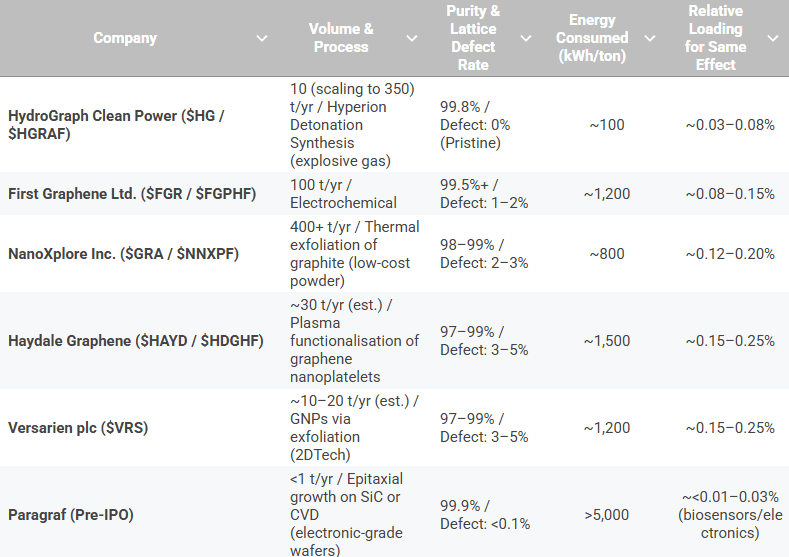
This shows the leading companies in the graphene production industry, highlighting the unique strengths of each. The energy usage does not include the energy required to mine and transport the graphite to the facility where it is processed into graphene. HydroGraph Clean Power stands out for its innovative detonation method, not requiring graphite which enables cost effective, energy-efficient, high-purity graphene, while having consistent quality even with production at scale, suitable for both bulk and advanced applications. Each company brings its own advantages to the rapidly evolving graphene market, with HydroGraph’s efficiency and versatility making it a strong competitor.
Long Horizon, High Conviction
Within the next 5-10 years, we are confident that graphene will seamlessly integrate into our daily lives, transforming industries and reshaping the way we interact with technology. Its unparalleled strength, conductivity, and versatility make it a prime candidate for advancements in electronics, energy storage, healthcare, and even sustainable construction. This presents an early entry opportunity for investors to capitalize on the mass adoption of a currently underutilized material. From ultra-efficient batteries to medical breakthroughs and eco-friendly solutions, graphene’s potential to revolutionize is undeniable, and its impact will likely become a defining feature of our modern world.
Explore the thrill of sourcing niche commodities, identifying hidden opportunities, and evaluating their growth and profitability potential. These materials go beyond short-term gains, offering the chance to drive innovation, reshape industries, and create meaningful impact. Thoughtful investments in such resources can contribute to a more sustainable future while strengthening your portfolio. Stay tuned for upcoming articles on other unique opportunities that can broaden your understanding and expand your investment horizons.
Disclaimer
This article was generated with the assistance of Google Gemini AI 2.5 Pro. The information contained herein is intended for informational and research purposes only. It does not constitute, and should not be construed as, investment advice, a recommendation, or a solicitation to buy, sell, or hold any securities or financial instruments. The views and analyses presented are based on publicly available information and are subject to change without notice. Readers are strongly encouraged to conduct their own independent research and consult with a qualified financial professional before making any investment decisions.
