Sub-Total: $0.00
Optimizing Longevity Through VO₂ Max
When looking at longevity in today’s world there are all sorts of different metrics that correlate with lowered risk of mortality.
Arguably the most important is VO₂ max, which serves as an important physiological predictor of longevity and a great marker of how your biological age compares to our calendar age. Having a low VO₂ max has been shown to be more dangerous than smoking, and even having diabetes or hypertension.
While 40-70% of our VO₂ max is determined by our genetics, the rest is up to us. Each of us have the capacity to substantially improve our VO₂ max and promote longevity.
So what is VO₂ max?
VO₂ max is the maximum amount of oxygen that your body can take in and use during exercise, measured in mL of oxygen per kg of body weight per minute or (mL/kg/min). The higher your VO₂ max is, the better your body is at efficiently delivering and consuming oxygen. An elite high endurance athlete will have a VO₂ max upwards of 80 mL/kg/min, whereas a “healthy” sedentary young male will be around 40 mL/kg/min, and at rest the average human body uses 3.5 mL/kg/min or 1 MET (Metabolic Equivalent of Task).
The Benefits Of A Higher VO₂ Max
Reduced Mortality
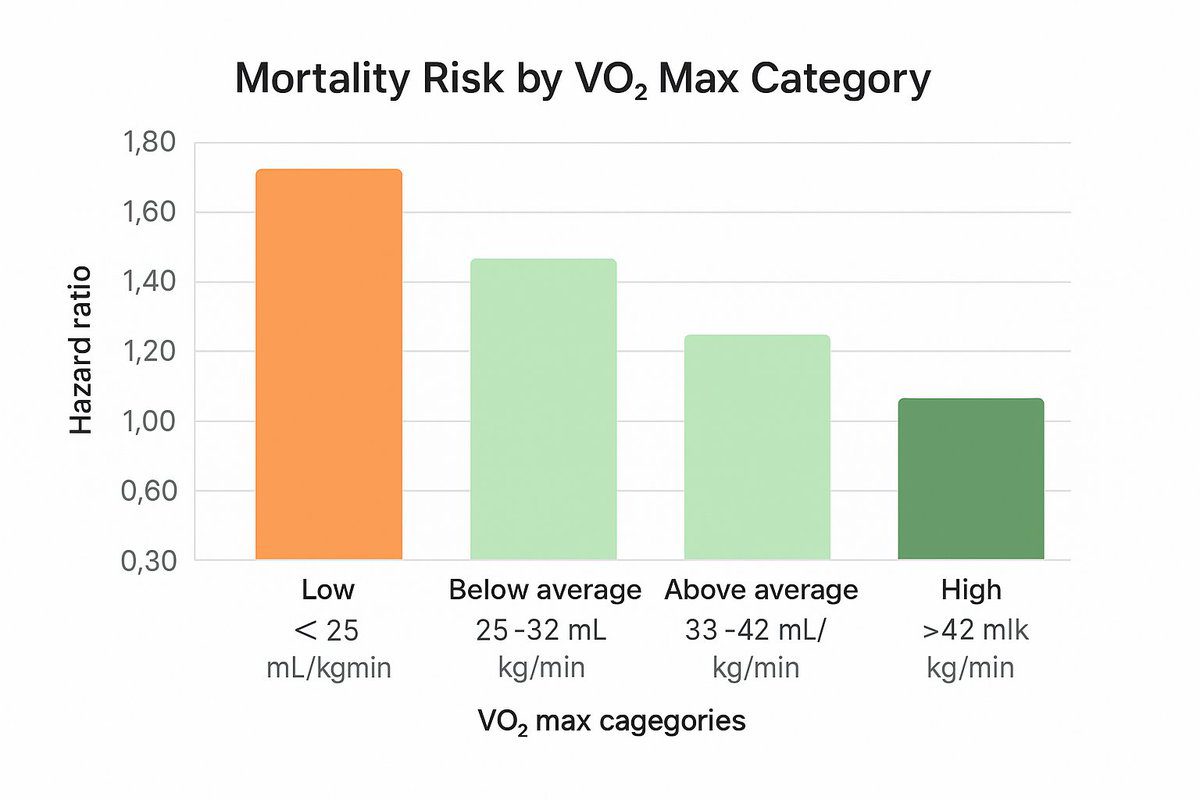
One of the most striking VO₂ max studies conducted was the JAMA Network Open (2018), which found that individuals with elite cardiovascular fitness had a 70-80% lower risk of death compared to those with low cardiovascular fitness. The results seemed to show no upper limit, meaning as VO₂ max increased, all-cause mortality continued to drop. Additionally, in this study low fitness levels resulted in a 5x higher risk of death vs the elite!
Another impactful mortality finding came from The Copenhagen City Heart Study, which found that a low VO₂ max was a better indicator of early death risk than high blood pressure, cholesterol, or BMI (Body Mass Index).
Systemic Health Benefits
In addition to the epidemiological evidence strongly linking high VO₂ max with reduced mortality, multiple systems within the body have been shown to function better when VO₂ max is high. These improvements almost certainly underlie the longevity gains.
Notable systems impacted by improved VO₂ max include:
Cardiorespiratory
- Improved cardiovascular efficiency
- Increased stroke volume
- Enhanced oxygen delivery
- Lowered resting heart rate and blood pressure
Metabolic
- Enhanced fat oxidation capacity allowing more fat burning at rest
- Increased capillary density and mitochondrial function
- Improved insulin sensitivity and glucose handling
Brain & Cognitive Function
- Improved cerebral blood flow, and increased BDNF (Brain-Derived Neurotrophic Factor) often referred to as “Miracle-Gro for the brain” enhancing neuroplasticity
- Lowered dementia and cognitive decline risk
- Reductions in stress and anxiety while building focus and resilience
Physical Performance & Recovery
- Decreased inflammation, and stronger immune function
- Greater endurance and stamina
- Improved recovery
- Less fatigue at submaximal effort
VO₂ Max, Independence and Aging
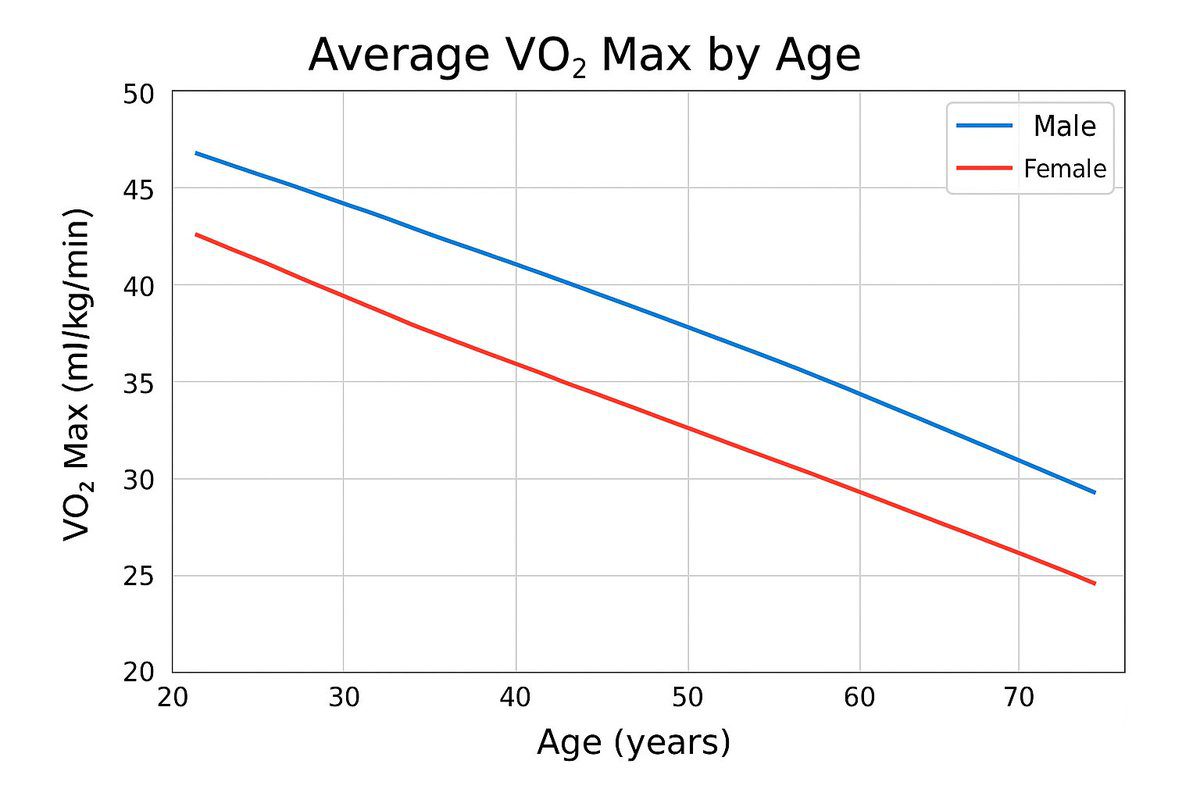
With age, VO₂ max declines roughly 10% per decade after age 30 in untrained individuals. This manifests as physical and mental decline as well as higher all-cause mortality. Although this is disturbing, if consistent training can be sustained or begun in old age, it can actually slow or even reverse the downward trend.
The “Independence Threshold”
Losing independence as we age is a fear most people face. Maintaining our VO₂ max seems to be crucial for independence, as experts have determined that a VO₂ max of 18 mL/kg/min is required to conduct basic day to day activities. Falling under this level increases risk of frailty and dependence, so working to avoid this should be a top priority for those who value their independence.
How do I test my VO₂ max?
There are many different ways to test your VO₂ max but the most accurate are those typically conducted in a lab with an oxygen mask used to measure your intake of oxygen and output of carbon dioxide. Typically, these tests will be supervised, take place on a treadmill or an exercise bike, and will gradually increase in intensity, speed, incline, or resistance. The test continues until the measured mask detects a plateau in oxygen consumption which represents your VO₂ max score.
Since lab tests are not accessible for everyone, wearable monitors are increasingly incorporating VO₂ max estimates which, while less precise than lab tests, often estimate within plus or minus 1 MET, or 3.5 mL/kg/min. If you want the best result with a wearable like Apple Watch or Garmin, use the exercise bike or treadmill and go until total exhaustion. As a warning, testing sometimes results in extreme exhaustion and in rare cases nausea. Always consult a physician before and have supervision while attempting!
The Bull Case for VO₂ max training
The large amount of evidence on this topic is now abundantly clear. There are established training protocols which can improve VO₂ max, and these improvements are accompanied by all the benefits outlined above.
According to the Norwegian HUNT Study, every +3.5 mL/kg/min increase in VO₂ max or the equivalent to 1 MET, is associated with a 12–15% reduction in mortality risk. With data from over 230,000 participants since its launch in 1984, the study remains one of the most comprehensive ongoing investigations into health and fitness today. So, get training!
It is important to note that everyone responds differently to training. There are high and low responders, with some people being able to increase it a lot and some not as much. However, everyone can improve their VO₂ max and there are many different methods for training. Regardless of which method you choose, it is always critical to target your bottle neck and progressively overload your body. For example, your legs might burn out during the test before your heart and lungs, so muscular endurance training of the leg muscles is needed. You will need to experiment with different training methods to discover what your bottleneck is, whether it be muscular, cardiovascular, or respiratory.
VO₂ max training Methods
Zone 2 Training
Zone 2 training involves maintaining a lower intensity, steady cardio exertion which puts you at 60-70% of your max heart rate for longer durations. This type of training activates PGC-1α, a key regulator of mitochondrial growth which increases mitochondrial density, improves cellular energy production, and enhances endurance capacity. It also stresses your aerobic system serving as the stimulus for adaptations which build your VO₂ max.
If you don’t have a heart rate sensor, a rule of thumb is to aim for a level of activity which puts you right on the border of being able to have a conversation and being too out of breath. You should be able to talk in full sentences, but be exerting yourself enough that you don’t really want to. Zone 2 training could be a walk, jog, or bike ride, anything that gets you to that heart rate zone, which depends on your current fitness. Do this training for an extended period of time for about 45-90 minutes, 3-6 times a week. This is low intensity training, so you can do it everyday without burnout.
High Intensity Interval Training (HIIT)
An additional method to train VO₂ max is HIIT training, which is very intense intervals of exercise at 85-100% of your max heart rate. This is maximum effort, alternating with recovery periods in between intervals. This training pushes your cardiovascular system to its limit, and can produce more VO₂ max gains than zone 2 training in the same amount of time making it a great option for busier people. HIIT should only be done 2-3 times a week for about 20-30 minutes. It is very important to include rest days in between due to the higher intensity. Recovery is needed in order to reap the full rewards of this type of training.
The Energetic Principles
The guiding principle behind Energetic Media, outlined clearly in Kevin Bambrough’s book “The Energetic Investor”, is that energy is the foundation of everything, not just in markets, but in life itself. That same idea applies directly to VO₂ max. This number is a biological expression of your energy capacity, how efficiently your body generates, moves, and uses oxygen to fuel your life.
VO₂ max is more than a fitness stat. It’s your functional reserve, your longevity compass, and a daily signal of how resilient you really are. Just as investors seek assets that produce more over time, VO₂ max is your personal dividend generator, a higher return on every breath and heartbeat.
You don’t need to be an athlete or a genetic outlier to benefit. With consistent aerobic training, whether through Zone 2 or HIIT, you can raise your VO₂ max. This in turn will boost your energy system, and return on the most valuable asset of all for a longer, more independent, and more free life.
If you want to stay up to date with the latest Energetic Insights subscribe to our newsletter and check out “The Energetic Investor” available on Amazon.
